Coming to Visit Us

Written by:

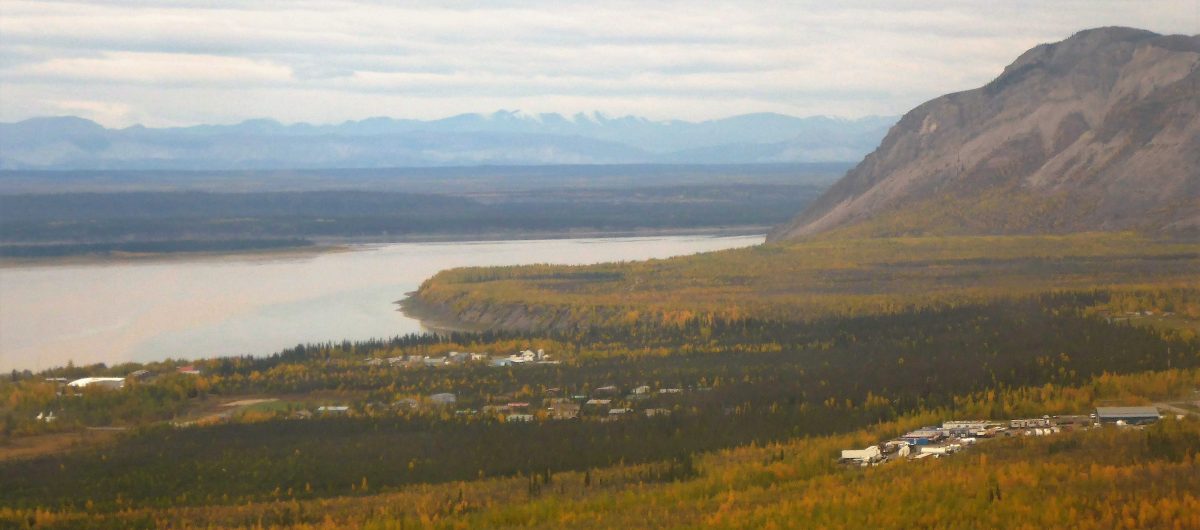
We’ve had a lot of people talk about wanting to come visit us. While we are really enjoying Tulita and would love to see you guys, I can’t in good conscience recommend visiting. This is mostly due to the prohibitive cost: it is $1,700 for the round-trip flight to Tulita from Yellowknife. You can get literally anywhere else in the world for that much money. Also, once you get here, it’s somewhat difficult to get from here to… well, anywhere. And there are limited tourist attractions in town. Here are some alternatives that we recommend:

Drive the ice roads

Sometime in the January to March window, you can drive here on the ice roads. This is a substantially cheaper option than flying, but also substantially more time consuming. It’s about an 8 hour drive to Tulita from Fort Simpson, and Google Maps can tell you how long it will take you to get there. You will also need an ice road suitable vehicle. On the plus side, driving the ice roads will be an adventure in and of itself, and there will be tons of aurora in the winter. The downsides include two hours of daylight per day.

Join us on an exciting northern adventure

If you’re going to spend the big bucks to get up here, we should go on an adventure. This would involve some advance planning (see the part about the costs to get out of here). I will post more about some of the exciting adventure opportunities up here as I learn about them. Most of them will have a pretty hefty price tag though.

Charter a flight

For groups, even very small groups, it may be cheaper to charter a flight than to take the regularly scheduled flights. I’m not sure about which companies to use or what the price would be, but this is definitely worth looking into.

If for whatever reason or by whatever means you do make it up here, there is a guest bed waiting for you.
The Canol Trail

Written by:

In my previous office in Vancouver, there was an old map of western Canada on the wall which went as far north as the territories. This map had a few divergences from, say, Google Maps, and one notable difference was that this map had a road drawn on it from Norman Wells across the Mackenzie Mountains to Ross River in the Yukon.

But no such road exists… or does it?!?

The second time I encountered this strange feature was at the museum in Yellowknife. This time, the map indicated a summer road from Ross River to the Yukon-NWT border and then a dashed line indicating a trail the rest of the way through to Norman Wells. I asked the museum staff what this was all about, and this was where I first learned of the Canol Trail.

During the Second World War, the American military was keen to build a pipeline from Norman Wells to Whitehorse to supply oil to the Alaskan front, so they funded the CANOL (Canadian Oil) project. 225,000 tons of equipment was brought up by river and portage, and the construction involved tens of thousands of people and took 15 months to complete. The war then ended a year later and the pipeline and road were abandoned, with many structures and equipment left behind.

The Yukon maintains their side of the road in the summer, but the 355 km on the NWT side is a hiking trail that is considered one of the most challenging and remote in Canada. Many people who start the trail are unable to finish it, usually turned back by high water levels at the river crossings (the bridges are long gone). It takes two to three weeks to hike and usually requires a food drop. History, wilderness, and challenge – everything I like in a hike. Any takers?

Further reading:

There’s hiking, and then there’s the Canol. Possibly North America’s most rigorous backpacking trail, this 355-kilometre trek follows the route of a defunct military road that once transected the Mackenzie Mountains. Tackling it is an exercise in self-sufficiency and endurance: Most hikers require three weeks to make it to Norman Wells, carrying food, survival gear and an inflatable raft to cross numerous swift, glacier-fed rivers.

My first cake

Written by:

In my defence, this was the first time I had made cake.

Still, it was Faye’s birthday and there’s certainly nowhere to buy a cake around here, so I thought I’d give it a go.

dsc_0232_medium

Cake making lessons learned:

  1. Have a cake pan. They’re designed (circularity and height and sometimes removable exterior) so that the cake doesn’t instantly fall apart when you take it out. A low, wide, long baking dish is not a good alternative.
  2. Leave the cake for a long time before trying to remove it from your low, wide, long baking dish. Otherwise, half will stay stuck to the bottom while the other half becomes a broken pile of chocolate.
  3. Making caramel (also first time) to glue your broken cake back together might seem like a good idea, but there are a few things to be careful of. Specifically:
    1. If your recipe calls for “sweetened condensed milk” and your local store only stocks “evaporated milk”, be aware that the latter is much more watery and you’ll have to spend an hour or two stirring your caramel over a burner to evaporate off the extra water without burning it.
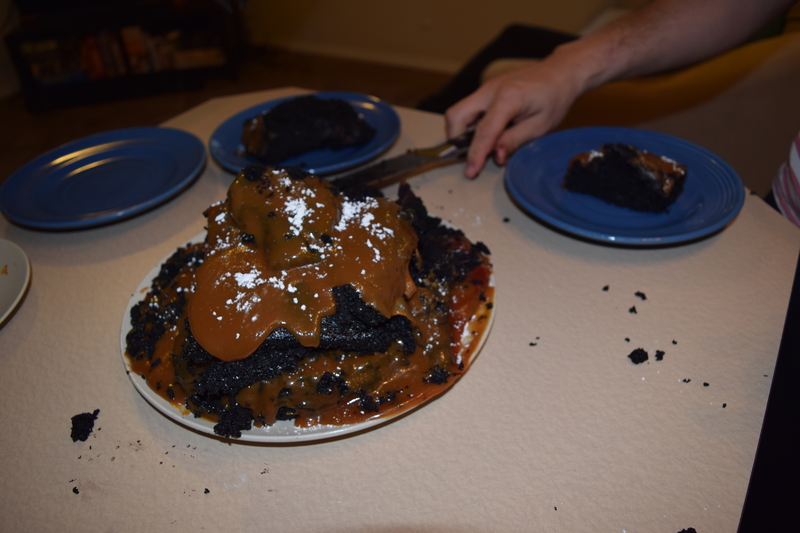
    2. Your caramel will, once cool, become MUCH, MUCH harder than it is while you’re cooking it. Anticipate this, otherwise you will be creating an layer of impenetrable cement in and around your collapsed pile of chocolate cake pieces.
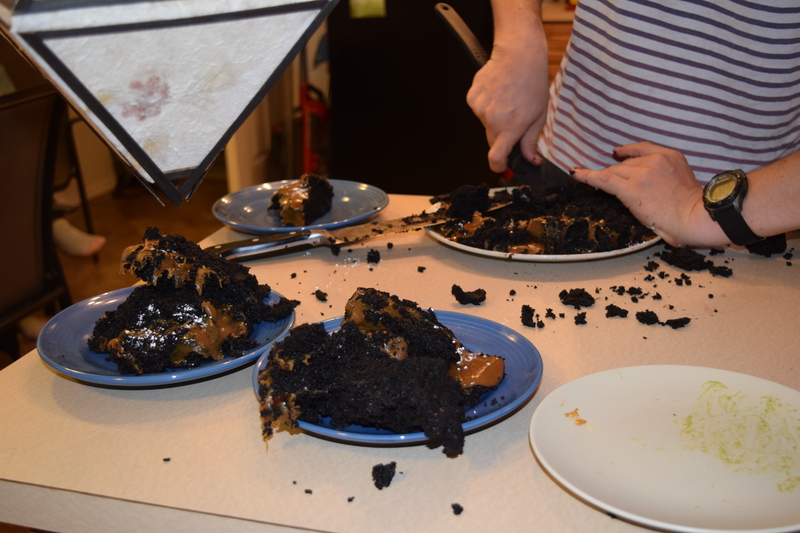
  4. Hiding some gummy bears inside the cake, for a fun surprise for the birthday girl is also a great idea. Just be aware that hot caramel will melt your gummy bears and fuse them into a single, hard, unbreakable, knife and human strength resisting, chocolate coated cake interior of doom.
  5. Finally, and I have to give credit to Faye for this tip, sprinkling some icing sugar on top of your pile of broken caramel-covered, gummy-doom-centred cake pieces will make it look like snow covering a local mountain! Then you can claim it was all by design.

dsc_0227_medium

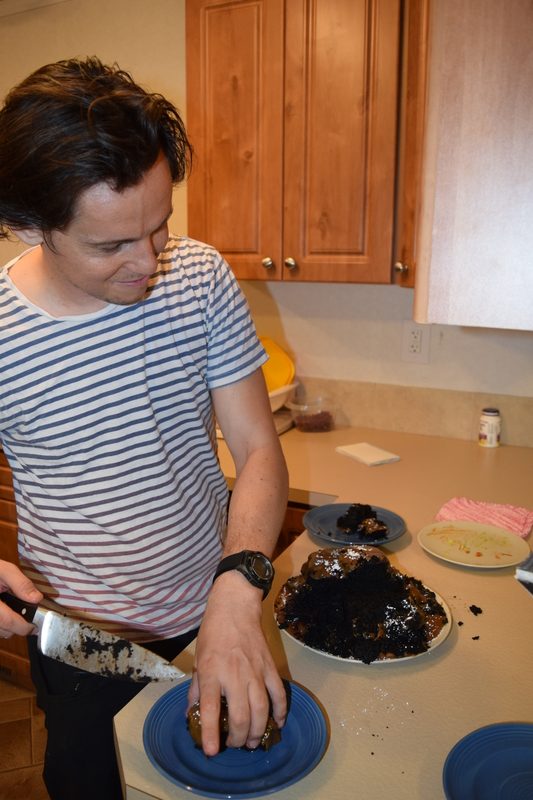
After a solid ten minutes of both of us desperately trying to rip the cake apart, Faye’s birthday guests were treated to some delicious chocolate caramel mess! Made with real love (locally sourced)!

dsc_0234_medium