
This entry is part of a three part series on my personal experiences with religion in a remote northern community.
Almost of all the religious white people I’d met in town were members of the Pentecostal mission. This starkly contrasts with the almost entirely indigenous Catholic ceremony I had attended.
I’d been confident about going to the Catholic mass. I’d been raised a Catholic and was familiar with the ceremonies. I was confident they’d welcome outsiders, that they wanted to spread their religion through kindness.
I was less confident about attending the Pentecostal service. I’d heard that the Pentecostal Christian denomination has a very different approach to religion. They’re biblical literalists: everything is exactly as the bible says and anyone who denies it is a god-hating liar. They practice faith-healing, speaking in tongues and other forms of magical religious performance. I worried they might be more inclined to make a harsh example of visiting outsiders (to shore up internal cohesion) than try to win them over with kindness.
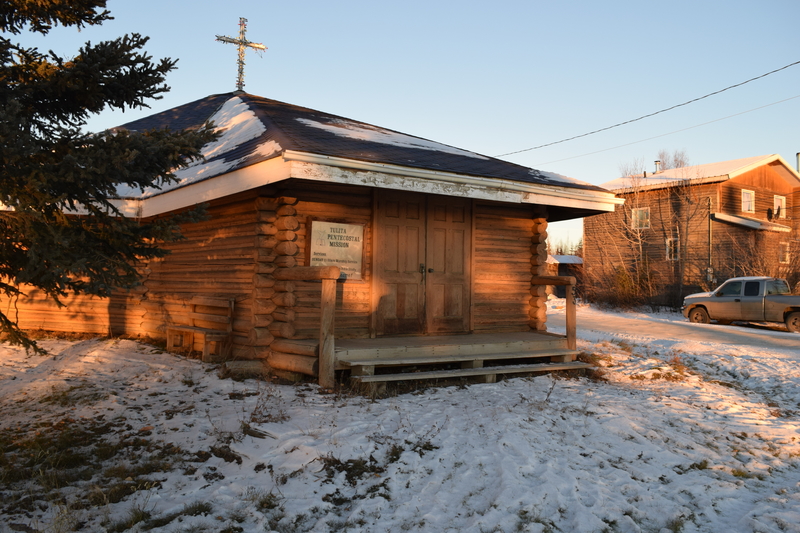
I arrived about 10 minutes late (after all, everything in town runs late) to find that the ceremony had already started. One of my neighbours was up on stage playing guitar, his wife and another woman—a school teacher—were singing. It was an upbeat religious song, but I couldn’t understand the words as I took off my boots and coat in the entry hallway. It was only after I’d entered and sat down that I saw that everyone else was still wearing their boots. Apparently the Pentecostal mission is one of the few buildings in town where people keep their shoes on.
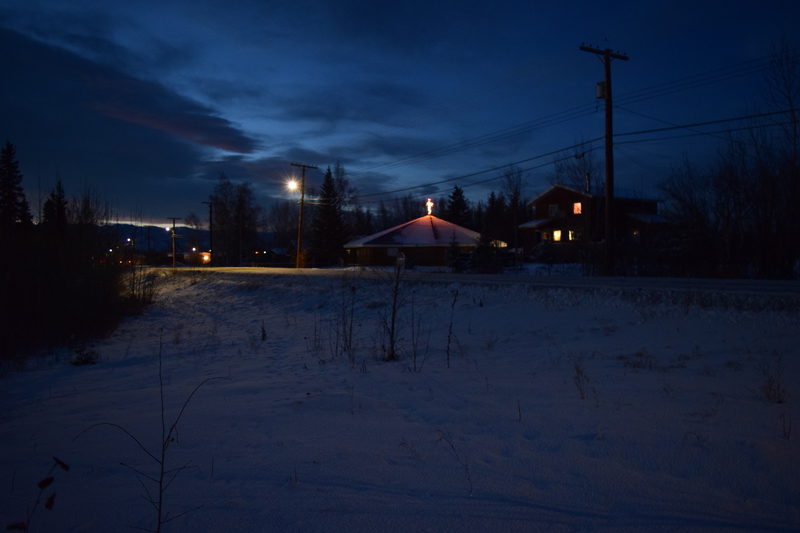
The building is an octagon. A third of it is devoted to a stage area, where the guitar and singers were performing. A full drum set is also on the stage but no-one is behind it. There’s also a large, ornate looking copy of the bible lying open in the middle of the stage. It seems like music performance is a regular part of ceremonies here.
Facing the stage and filling the middle third of the octagon are three rows of chairs. Each row has four chairs and there are two columns of them, with an aisle down the middle. There is a central post in the middle of the building, right in the aisle, in middle of the chairs. A digital projector is attached to it, casting the song words onto a white screen beside the stage.
The back of the octagon has small shelves of bibles and other religious books. The Pentecostal minister, Troy, is standing there as I walk in and nods to me.
Aside from me there are a total of ten people present. Nine of them are white. The minister, his wife and their daughter; the biblical scholar, his wife the school teacher and their daughter, my two neighbors and the teacher playing on stage. There’s also one older indigenous woman present, sitting at the far side and right at the back. She leaves mid-way through the ceremony.
The performers spend 10 more minutes playing simple, up-beat, songs that focus on praising god. They encourage other audience members to sing. “I promise, God doesn’t care how bad you sound,” one of them calls out. But mostly the audience only mumble.
After the songs the minister gets up to talk to the believers. He encourages everyone to have their bibles ready. Someone gets up and fetches one of the bibles from the shelves and brings it to me.
The next 40 minutes are comprised of the minister talking about the importance of truly accepting god in your heart rather than merely saying that you do. Occasionally he will call out the location of a passage in the bible for everyone to turn to, and ask for a volunteer to read it. All the passages are from the later books of the new testament: Romans, Acts, and so on, that record the efforts of the early Christians to spread their freshly fissioned faith. Each passage is read divorced from its context. It makes it feel like the creator of the universe has hidden an instruction specifically for you, camouflaged in ancient correspondence between people who lived 20 centuries ago.
Each passage we read out is a snippet instructs us to truly believe in Jesus Christ, in our hearts rather than merely by our words or acts.
Between these readings Troy, the minister, tells anecdotes to drive home the point. He describes a science experiment where a teacher explains the laws of physics and pendulums to his class. [After audience members correct his pronunciation of “pendulum” several times, Troy gives up and moves on with the story: “So anyway the thing about the penuluns, or whatever you call them…”.] The teacher has taught the class to trust the laws of physics and of pendulums. But, when his asks them to sit just beyond at the far end of a pendulum’s arc and swings it towards their face, they still move away. So too those who don’t truly love god will move away in their actions even though they say they love him.
At one point, between quoted passages, he asks us:
If terrorists stormed in to this building now and demanded to know who was a Christian, because they would kill all the Christians, what would you say? It’s easy for us to say we have God in our hearts because our lives are easy, but would you be willing to stand up and declare your trust in God if you were tested?
He approaches this same theme from different angles for the full 40 minutes.
Afterwards, the guitarist and singers return to the stage and lead us through ten more minutes of songs of praise.
After the ceremony the school teacher who was singing comes to chat with me. She encourages me to talk to the principal about volunteering at the school, and I say that I will. The biblical scholar comes over to chat and encourages me to come to bible study. The minister and his wife suggest I should bring my wife next week. Everyone is very kind.
Soon I have my boots and heavy coat on and am back out into the freezer, trudging home.