I’ve started snaring snowshoe hares this winter. They’re a hare with giant back feet, for staying aloft on the snow. They’re brown in summer but turn white in the winter for camouflage. Adults weight about 1½kg of mostly lean, red meat.
A snowshoe hare
Snaring rabbits (or rather, hares; but let’s just say “rabbits” for simplicity over accuracy) is a common practice up here. Though local trappers usually focus on animals that yield more valuable pelts, they’ll set a few snares for bunnies too. A few people have told me that they’re mostly used to make a delicious rabbit stew.
The rabbit snare is a very simple trap. It’s just a loop of wire, set on the ground at about rabbit height. The wire is twisted around itself so that any pressure against the loop makes it tighten. Ideally, the snare is placed in somewhere that rabbits have passed before, and then a few sticks placed in the ground around it to encourage the rabbit to go through the snare. When they enter the snare, it tightens and a rabbit will usually jump away hard in panic and keep jumping and pulling, breaking their neck or choking them quickly. It’s a quick, merciful end. Wire snares are considered one of the most humane ways to trap.
A rabbit snare
Except, apparently, when it doesn’t go like that. Sometimes, a rabbit won’t panic. Sometimes they’ll realise they’re stuck and hunker down instead. Eventually either a predator will find and eat them, they’ll freeze (it’s been -50°C lately) or the trapper will return and end their ordeal.
A trapper usually heads out to check their snares at dawn, as soon as they can see. People tell me that it’s to beat wolves, wolverines, foxes and other rabbit-lovers to the tasty, immobilised meal. If that was all there was to it, I’d stay in bed most days—let the hungry predators have an extra meal, I can sleep in and just go to the store if I need to. But I have been heading out at the break of dawn to check my snares, every single day.
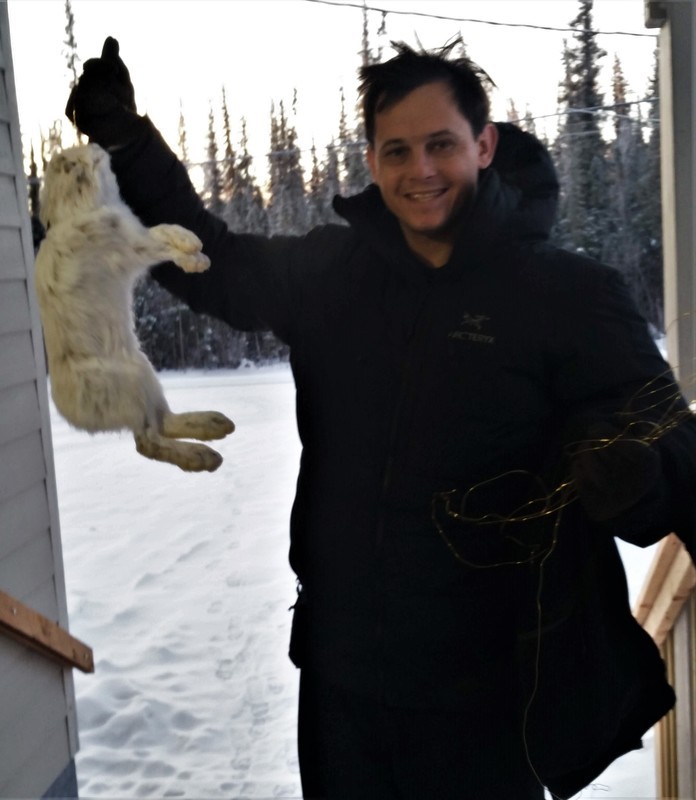
Maciek, arriving triumphantly at his mother-in-law’s door with his first ever snared snowshoe hare.
Call me a naive, bleeding-heart southerner, but to me it feels like the rabbits and I have a far more serious compact. I don’t know what goes through a rabbit’s head; probably not much. I don’t know if a rabbit feels or experiences things the way I do, if there’s an “I” behind its eyes, if there’s something that it’s like to be a rabbit. But I suspect that there is. I don’t have any problem with hunting or trapping for food, it’s the way people and other predators have lived up here almost as long as there has been life here. It’s certainly more ethical, humane and sustainable than the ways that most of the meat we eat comes to our plates, and yet…
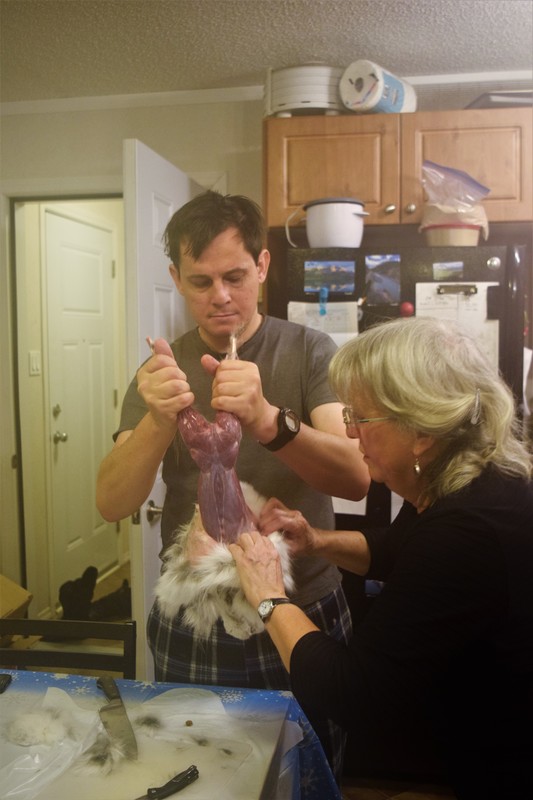
Maciek and Joyce—Faye’s mum, who was visiting over Christmas—skinning a hare.
Every morning I wake to the awareness that I’ve deliberately set traps out in the world, traps that my prey can’t comprehend, traps that could have put them into a terrifying situation. Even now there could be another conscious awareness out there, another sentience, alive but trapped, struggling in confusion and fear because of something that I deliberately, knowingly did. The least I can do is drag my lazy arse out of bed as soon as it’s light enough to see (thankfully that’s around 10:30am these days), and end their suffering quickly.
This is my promise, my compact with my prey. Yes, I will use tools beyond what they can comprehend to try to catch and eat them, but I will also do whatever I can to make their end quick and painless. I’m sure life will eventually throw hurdles and conflicting priorities at me serious enough that I’d break that commitment, but it turns out that “It’s cold outside and I wanna stay in bed” is not among them.
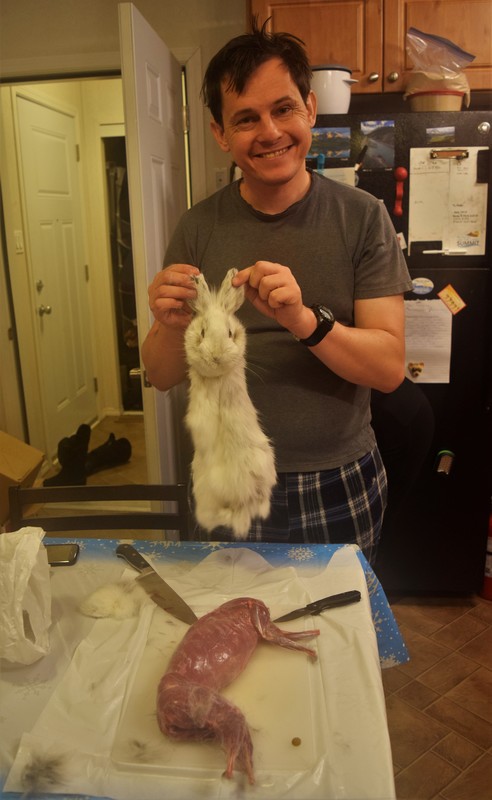
Trapper’s pride. One skinned hare, ready for eating and tanning.
So far I have only succeeded in snaring one snowshoe hare, and it was already dead when I arrived. I’m not looking forward to eventually finding one still alive. Apparently the technique is to put your thumbs behind its neck, your fingers under its chin and pull up and push through, driving your thumbs through its spine and killing it instantly.
Coming up soon (when I’ve caught enough): “Rabbit Recipes” and “Working with Rabbit Fur Textiles”.
*Note: this story was written in January, but not published until March. Maciek has since caught 3 rabbits in total.
The world around me used to be still and frozen, but it has started to come alive. Most of the snow has melted away. What remains is wet, sloppy snowy remnants that will soon become the bog. The walls of dead-looking, human-high sticks that lined the side of the winter road are becoming trees again, with little green buds appearing all over them. The road itself is now a treeless stretch of mud and ditches and puddles, and for a moment I’m flying.
My feet have left the quad as I hit the peak of my parabola. Then my hands, gripping the handlebars—not so tight that they’ll get exhausted, not so loose that they’ll let go; elbows bent ready to absorb the impacts—jerk me forward. My moment’s flight is done and I’m violently hurtling through this world on top of a 300cc engine. The quad’s low pressure tyres fling a constant barrage of mud up behind me. The suspension might be absorbing some of the impacts, but mostly that’s a job for my knees. I’m in a permanent half-squat over the seat, pulling the vehicle in to me, pushing it back into the ground, thrusting my weight back for more traction, thumb locked to the accelerator, eyes constantly scanning the ground rushing towards me, ready to react.
A rare, clear dry patch—time to put on some speed.
A ditch!—take it head on, absorb the impact, accelerate hard out of it so there’s enough momentum to keep flying through that massive stretch of thick mud.
A puddle of deep, dirty, muddy water—my quad and I are splashing straight through, water flying everywhere, droplets flashing around me in the perpetual northern daylight, coating us both, my quad and I, in mud and glory.
I love it out here.
Tulita is a little 1km radius patch of town surrounded immediately by endless wilderness. It starts directly behind our house, and goes on for hundreds of wild, endless human-free kilometers in all directions. Last year, the summer made that wilderness into dangerous, threatening, stifling, intraversible bog. It was too hard going to move very far through, especially with my shitty heart, and it was full of bears and other very real dangers. It kept me a prisoner in town. A fragile, helpless being huddling in an island of civilised safety. This year, it has become an awesome, massive adventure playground. I hadn’t realised I needed a quad, but I so desperately, desperately had.
I take my gun out with me, bouncing along in a sling on my back, and I try to shoot any grouse I see. “You’re not really hunting though, are you?” My neighbour asks. “You’re out for a rip”. He couldn’t be more right.