Religion: Pentecostal

Written by:

This entry is part of a three part series on my personal experiences with religion in a remote northern community.


Almost of all the religious white people I’d met in town were members of the Pentecostal mission. This starkly contrasts with the almost entirely indigenous Catholic ceremony I had attended.

I’d been confident about going to the Catholic mass. I’d been raised a Catholic and was familiar with the ceremonies. I was confident they’d welcome outsiders, that they wanted to spread their religion through kindness.

I was less confident about attending the Pentecostal service. I’d heard that the Pentecostal Christian denomination has a very different approach to religion. They’re biblical literalists: everything is exactly as the bible says and anyone who denies it is a god-hating liar. They practice faith-healing, speaking in tongues and other forms of magical religious performance. I worried they might be more inclined to make a harsh example of visiting outsiders (to shore up internal cohesion) than try to win them over with kindness.

dsc_0107_medium
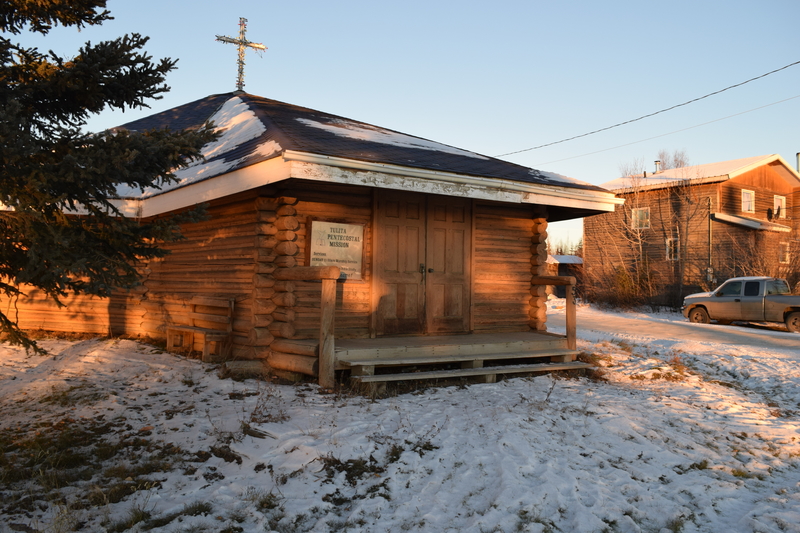
The Tulita Pentecostal church

I arrived about 10 minutes late (after all, everything in town runs late) to find that the ceremony had already started. One of my neighbours was up on stage playing guitar, his wife and another woman—a school teacher—were singing. It was an upbeat religious song, but I couldn’t understand the words as I took off my boots and coat in the entry hallway. It was only after I’d entered and sat down that I saw that everyone else was still wearing their boots. Apparently the Pentecostal mission is one of the few buildings in town where people keep their shoes on.

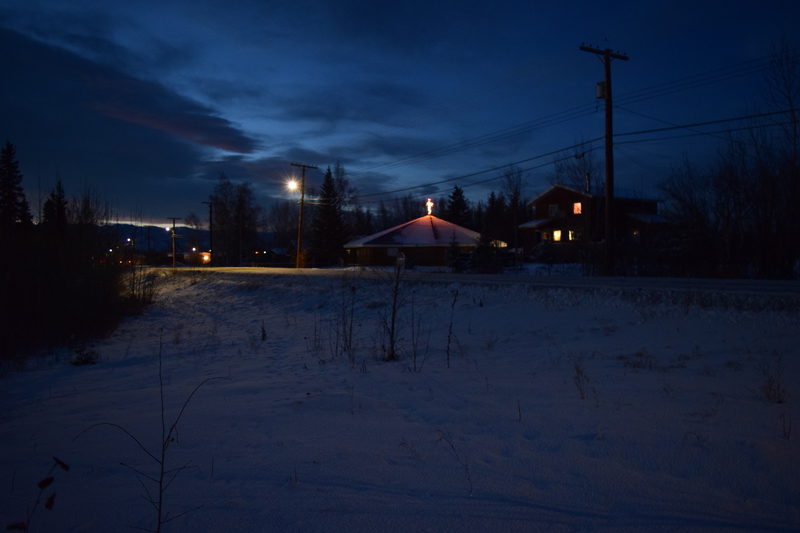
The building is an octagon. A third of it is devoted to a stage area, where the guitar and singers were performing. A full drum set is also on the stage but no-one is behind it. There’s also a large, ornate looking copy of the bible lying open in the middle of the stage. It seems like music performance is a regular part of ceremonies here.

Facing the stage and filling the middle third of the octagon are three rows of chairs. Each row has four chairs and there are two columns of them, with an aisle down the middle. There is a central post in the middle of the building, right in the aisle, in middle of the chairs. A digital projector is attached to it, casting the song words onto a white screen beside the stage.

The back of the octagon has small shelves of bibles and other religious books. The Pentecostal minister, Troy, is standing there as I walk in and nods to me.

Aside from me there are a total of ten people present. Nine of them are white. The minister, his wife and their daughter; the biblical scholar, his wife the school teacher and their daughter, my two neighbors and the teacher playing on stage. There’s also one older indigenous woman present, sitting at the far side and right at the back. She leaves mid-way through the ceremony.
dsc_0170_medium
A view of the Pentecostal church at night

The performers spend 10 more minutes playing simple, up-beat, songs that focus on praising god. They encourage other audience members to sing. “I promise, God doesn’t care how bad you sound,” one of them calls out. But mostly the audience only mumble.

After the songs the minister gets up to talk to the believers. He encourages everyone to have their bibles ready. Someone gets up and fetches one of the bibles from the shelves and brings it to me.

The next 40 minutes are comprised of the minister talking about the importance of truly accepting god in your heart rather than merely saying that you do. Occasionally he will call out the location of a passage in the bible for everyone to turn to, and ask for a volunteer to read it. All the passages are from the later books of the new testament: Romans, Acts, and so on, that record the efforts of the early Christians to spread their freshly fissioned faith. Each passage is read divorced from its context. It makes it feel like the creator of the universe has hidden an instruction specifically for you, camouflaged in ancient correspondence between people who lived 20 centuries ago.

Each passage we read out is a snippet instructs us to truly believe in Jesus Christ, in our hearts rather than merely by our words or acts.

Between these readings Troy, the minister, tells anecdotes to drive home the point. He describes a science experiment where a teacher explains the laws of physics and pendulums to his class. [After audience members correct his pronunciation of “pendulum” several times, Troy gives up and moves on with the story: “So anyway the thing about the penuluns, or whatever you call them…”.] The teacher has taught the class to trust the laws of physics and of pendulums. But, when his asks them to sit just beyond at the far end of a pendulum’s arc and swings it towards their face, they still move away. So too those who don’t truly love god will move away in their actions even though they say they love him.

At one point, between quoted passages, he asks us:

If terrorists stormed in to this building now and demanded to know who was a Christian, because they would kill all the Christians, what would you say? It’s easy for us to say we have God in our hearts because our lives are easy, but would you be willing to stand up and declare your trust in God if you were tested?

He approaches this same theme from different angles for the full 40 minutes.

Afterwards, the guitarist and singers return to the stage and lead us through ten more minutes of songs of praise.

After the ceremony the school teacher who was singing comes to chat with me. She encourages me to talk to the principal about volunteering at the school, and I say that I will. The biblical scholar comes over to chat and encourages me to come to bible study. The minister and his wife suggest I should bring my wife next week. Everyone is very kind.

Soon I have my boots and heavy coat on and am back out into the freezer, trudging home.
Religion: Catholic

Written by:

The catholic ceremony was scheduled for 11am, but didn’t start until 11:20. People trickled in until about 11:40. Nothing here starts on time.

dsc_0149_medium
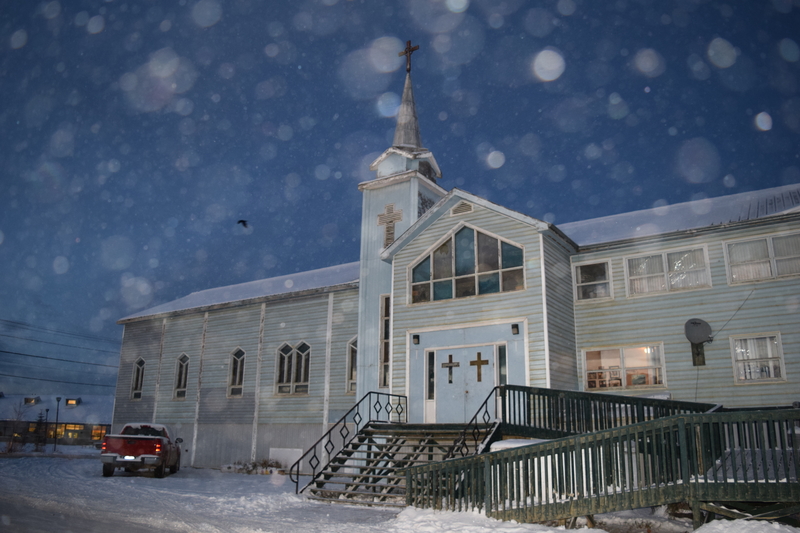
The Catholic church

The church building has two halves: the north wing is church-proper and the south wing a residential section where I assume Sister Celeste lives. When you first enter there is a large room full of shoe racks for you to take your shoes off. Almost every building has one of these in Tulita since in the winter your boots are caked in snow and in summer they’re covered in mud.

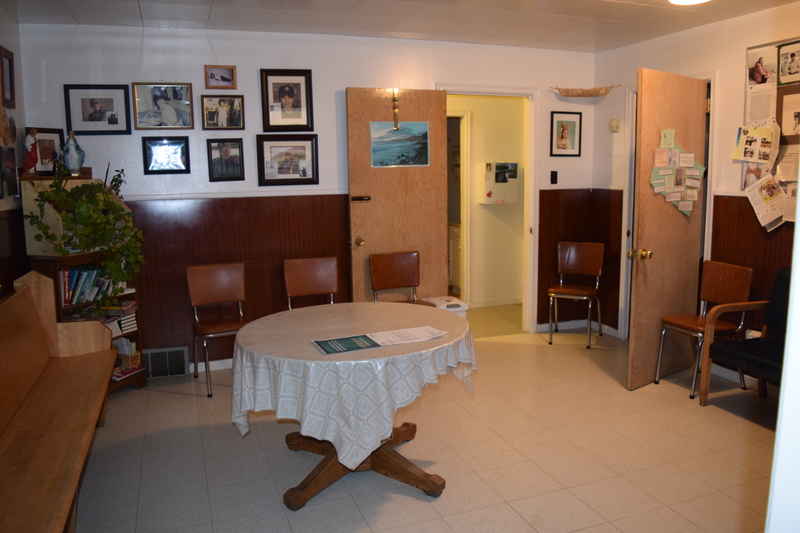
After the shoe room there is a small antechamber with chairs around the outside. There are pictures of locals on the walls and on Sunday there’s a full coffee urn on the table.

dsc_0152_medium
The catholic church antechamber

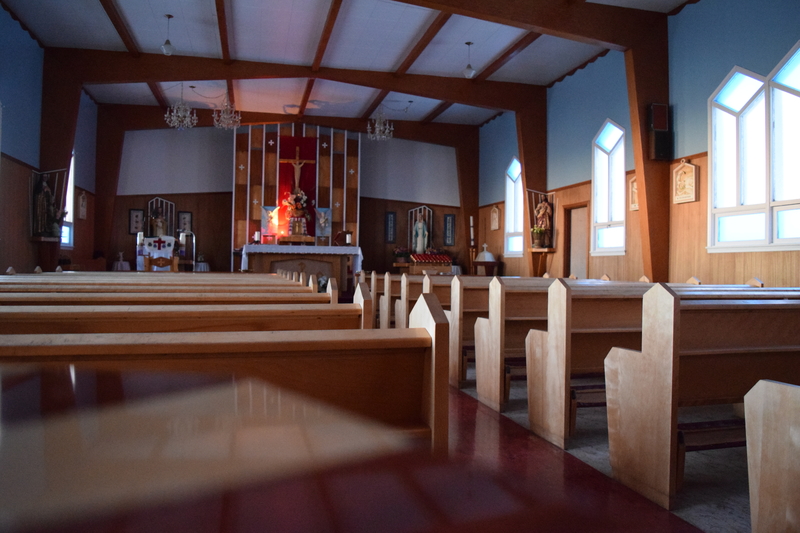
Turning to the left leads you to the main church section. The church part has an large alter, long wooden pews facing, stained glass windows and statues of holy figures highlighted by neon bulbs.

dsc_0160_medium

There are about 45 attendees. Besides myself and Sister Celeste, everyone attending the ceremony is indigenous; either Dene or Metis. Most of the faithful are old; I’d guess 65 years old and older. There are a handful of younger women—maybe five of them. A couple of them have young husbands with them. Two young boys, maybe about 10 years old and surrounded by their parents on each side, are punching each other in one of the middle pews. Some younger kids had been left behind in the antechamber and their laughter and the thumping of their running feet occasionally punctuates the otherwise somber proceedings.

A picture of Sister Celeste receiving the Catholic Missions In Canada’s 2016 St. Joseph Award for her outstanding missionary service

Here is the ceremony I witnessed.

[5 Minutes] Prayer dedications.

Sister Celeste begins by standing at the front, between the front most two pews. She doesn’t ascend the dais to the alter, she stands among the audience. She reads out prayer dedications.

Today let us pray for so-and-so, who is sick; for so-and-so’s sister who is visiting, for all those buried in both cemeteries and out on the land, and for all those left behind.

Several people seem to have submitted dedications for her to read, most mention those buried in both cemeteries and out on the land.

[20 Minutes] Prayer intonement

Sister Celeste begins by intoning two lines of the “Hail Mary” prayer. The audience responds in a low drone, intoning the next two lines as a refrain. This is repeated several times. It’s hard to make out the words in the audience response as all the voices merge together in a low drawn out sound. Some people may be responding in the local language (North Slavey) rather than English, it’s hard to tell.

After the Sister has repeated this call and refrain for about five minutes, a new voice takes over her role as leader. I can’t see the speaker but the voice is old. It’s not speaking English, most likely it’s speaking North Slavey. It’s a soothing drawn out sound, more like singing than speaking. The voice is somewhat cracked with age, but that merely heightens the grave and profound tone of the ceremony. It feels like something important and powerful is happening. Most of the audience responds in Slavey, though a few English voices are mixed in. I recognize one as Sister Celeste’s. The length of the call-refrain makes me think it’s the same prayer in another language.

Two more leaders take over, a younger-sounding woman and then Sister Celeste again.

Between each prayer intonement leader, Sister Celeste calls out a numbered mystery—“The third mystery is …”—but I have been lulled into an altered state by the long period of strange audio, the collective punctuated drone, and I don’t remember the mysteries.

[5 Minutes] A song

Sister Celeste puts up the lyrics to a religious song up on an old fashioned overhead projector. She starts the congregation singing. In contrast to the low prayer drone we have just finished, this song is high and bright. Everyone stands up in their pews to sing and everyone—the men, the women, everyone—is right on key.

[5 Minutes] A story from the bible

Sister Celeste stands behind a lectern. It’s raised above the audience, but is to the side of the alter. She reads a story from the bible. It’s that of Zacchaeus the Tax Collector—a greedy man who had cheated his peers, but who said he would change his ways when Jesus stayed at his house.

[5 Minutes] Sister Celeste’s interpretation (Homily)

The Sister interprets the story she’s just read. It’s about how each of us need to reach out to those around us, she explains, and bring them to the love of Jesus. Especially those who are the most wicked and need Jesus most.

Each one of us needs to be touched in our heats to help others, because Jesus loves us. We need to learn to soften our hearts and pass on that love to other people. We must convince them with kindness, not with harsh words.

She also shares a story from her past, that this reading reminded her of. She was always short and stubby and fat, she explains. So she would hide in a church as a child to avoid the mockery of the other children and just stare at the statue of Jesus. This is when she first felt his love.

[3 Minutes] More dedicated prayers

Sister Celeste, still at the lectern, lists many people and causes who should be prayed for. They include locals who need help, a baby about to be baptized, and world leaders who need wisdom. After each prayer recipient, the faithful respond “Lord hear our prayer.”

[2 Minutes] Collection

Some women at the front sing a song in Slavey while two children come around with collection plates. Everyone puts some money in them. Except for me, because I had not known to bring any.

[10 Minutes] Main Mass (Liturgy of the Eucharist)

Finally Sister Celeste stands behind the alter and performs the core ceremony of the Catholic mass. She blesses the bread and wine and leads the audience in another call and response that is standard to all catholic masses. It is a translation of an old Latin ceremony, but the translation has changed since last I was at a catholic mass, so I no longer know the replies.

Eventually the congregation line up in the center aisle, between the pews, and receive a piece of bread—a very thin round wafer—from Sister Celeste directly on their tongue.

[2 Minutes] Final announcement

Finally, as people are rising to leave, Sister Celeste has one more announcement. The bishop will be in town from Wednesday to Friday. He’s coming to appraise the building and gather funds for it to be repaired. There’s trouble with the foundations. He may ask the local Catholics for contributions. He’s very approachable and will listen to your confessions.

After the mass

As I put on my shoes I see that most people are now gathering in the vestibule to socialise. One woman has rushed out to fetch cup cakes from her car.

This is a key part of the magic. The time when people who’ve just shared in a long, solemn ceremony affirming their faith, and their commitment to being good people who spread love not hate, mingle and strengthen their social bonds. This is how people know who to trust and who to help. This is how cooperative communities can arise in the harshest of historical moments, how religions like Christianity spread in the decaying Roman empire, how religion reforms vicious frontier towns into thriving, safe cities. Emerging from the daily social tumult of  the self-interested masses, small groups of cooperative people voluntarily gather to show that they’re ready to sacrifice their own time and interests in dedication to a higher power. They mingle, they bond, they recognise and trust each other, they help each other succeed.

I wasn’t ready to intrude on such powerful community building yet.

As I put on my shoes, someone asked me: “Why did you come here?”

“I used to be a catholic when I was a child.” I explained. That appeased them. “Then you’re still a catholic!” After that everyone seemed welcoming and friendly, but I still went on my way.

Next week I will visit the Pentecostals.

Religion: Introduction

Written by:

You’ll remember this conversation when you’re standing before the lord?

It was phrased as a question but it felt like a threat. It also finally brought the tirade to a close.

I was in the mechanic’s workshop behind the Pentecostal mission. I was chatting with the Pentecostal minister and another Pentecostal faithful, a white guy. They were working on fixing a quad—a four-wheel all terrain vehicle, they’re very popular up here.

A picture of a quad from wikipedia. I rode one that same day, they’re awesome fun.

We’d been saying something about the weather and I’d mentioned climate change. They’d insisted it wasn’t real.

Walking fearlessly towards controversy, I replied that surely these days climate change wasn’t controversial anymore? You just needed to look at historical weather data to see the average global temperature was increasing steadily.

“Well how far back do those records even go?”

One of my interlocutors replied.

I made a judgement call here. This was just some guys shooting shit in the workshop so it wasn’t worth getting in to the Pleistocene-Holocene transition and variance in variability between geological epochs. Let’s just stick to the safe, easy terrain of stable climate trends in the Holocene. So I said,

“Well, we’ve got good records for the last ten thousand years.”

That’s what kicked it off. Ten solid minutes of two-man tag-team tirade. The world was only ten thousand years old because their god wouldn’t lie to them. Evolution was a conspiracy by atheists to deny accountability for the stains on their souls. They certainly weren’t related to any monkeys. Then, with an inquiring admonition to think back on this when face to face with universe creating powers, we went right back to quad-fixing banter.

I’d known people were quite religious up here, but I honestly hadn’t expected young earth creationists. I’d thought they were almost extinct. I’d been wrong. I’ve since looked up the data and, in the latest 2012 survey, about 22% of Canadians had claimed the earth was created recently by a god.

I guess I’ve been living in a secular, academic bubble. People with similar beliefs cluster together. Before I’d clustered with the science-trusting types and now I’m living in a very different cluster at the other extreme of the distribution.

This was my first ever experience of being admonished for thinking the world was too old. It made me realise it was high time I learned about the town’s churches.

I read a book a few years ago. The Churching of America. It’s a fascinating economic analysis about how different religious sects and churches compete for followers. They employ different kinds of ceremonies, techniques, different ways of tapping into emotions and spreading beliefs. Different techniques worked in the large established cities in the American east—the sombre cathedrals and dry, droning ceremonies of the Catholics—than in the wild, sparse, westward spreading frontier—the visceral intensity of Baptist revival meetings, for instance. As decades passed and successive frontiers were civilised and grew dense, so too shifted the relative frequency of different religious beliefs, practices, of different churches, of numbers of pews in churches and of numbers of butts in the pews. Intensity, novelty and extremity worked on the frontiers of civilisation but less so at is core. The book has many other fascinating insights and I recommend it.

North America has been densely settled now, but our town is still sitting at  the least accessible edge. There are three churches in town.

dsc_0120_medium
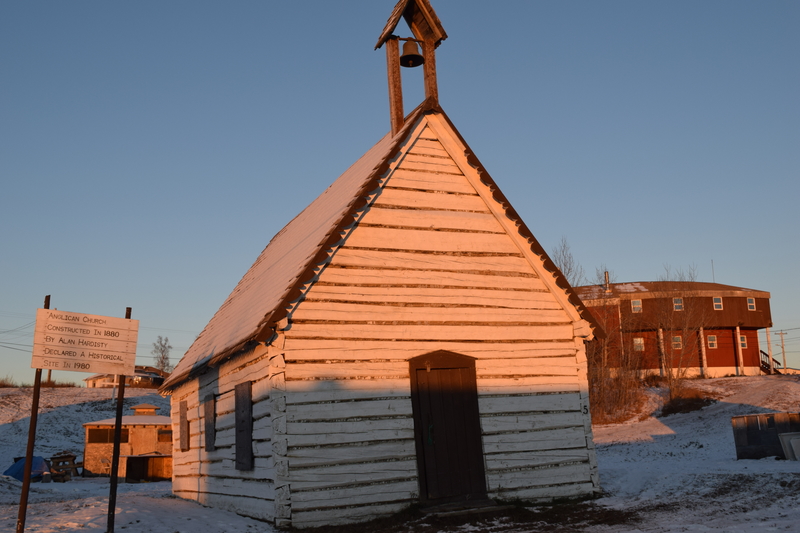
The town’s only historical site: an abandoned Anglican church.

The first is the old abandoned Anglican church. The only historical site in town mentioned in the only guide book (a guide to canoeing the Mackenzie river) that mentions us. I’ll look in to its history.

dsc_0149_medium
The town’s Catholic church

The next is a catholic church. It’s run—has been since 1979—by Sister Celeste. She has won multiple awards for her service to the community, including the 2016 St. Joseph award and the 2008 Prime Minister’s Awards for Excellence in Early Childhood Education.

dsc_0107_medium
The town’s Pentecostal mission.

The final church is the Pentecostal mission. The Pentecostals are known for biblical literalism and “charismatic” practices like speaking in tongues faith healing. Their leader—Troy, I’m not yet sure if he’s called a minister or a preacher or what the difference is—is a brash young guy. He’s the one who was telling me all about how silly evolution was because the world was too young for it.

I’ll attend the catholic and Pentecostal ceremonies—they’re on at the same time so it’ll take a couple of Sundays—and record them as accurately as I can here.

There’s also a young theologian who just moved to town—he’s doing a Masters of Theology—with his daughter and his wife, who teaches at the local school. I’ve met him once—at the school’s thanksgiving feast—and we had a very nice conversation about the history of the reformation. He seems like a bright, interesting, historically well-informed guy. He’s starting a bible study group soon “with the aim being to accurately understand and apply Scripture.” I’ll attend that too. Perhaps he’ll have a more academic, historical perspective on the communities and practices here.