The Winter Road

Written by:

As mentioned in an earlier post, Tulita is accessible for a few months of the year via the winter road system:

The 15-year historical average opening dates for the road to Tulita is January 1 to March 28. This season, it opened in late December, but it’s still not open to large trucks. The road mostly follows the alongside the river, but there are several places where it goes right over the river, which requires a minimum ice thickness (25″ for large trucks).
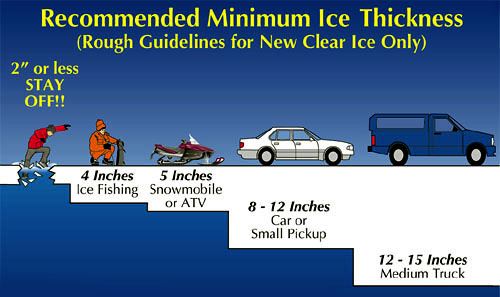
Once the ice is thick enough for large trucks, there will be an influx of supplies making their way into town.

Of course, this system is not foolproof. Last year, a fuel tanker went through the ice on the road to Deline:

So hopefully we won’t see a repeat of that this year.
_DSC1557
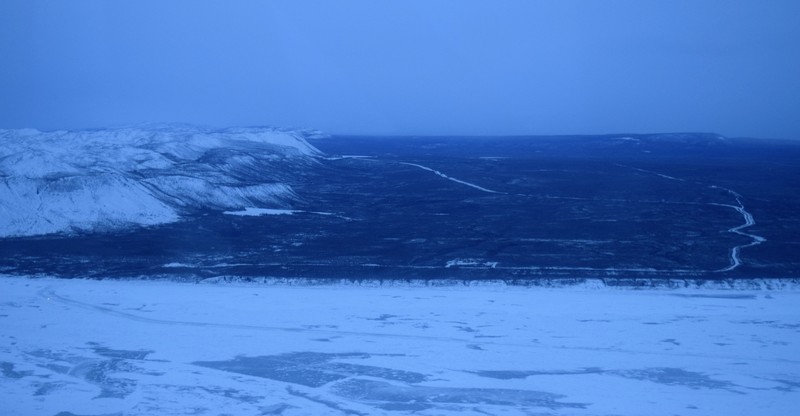
The winter road along the Mackenzie, from above

I went to Norman Wells for a meeting this past week, and we drove there. It took 2.5 hours to cover the 90km distance (I’ve heard that it can be done as fast as 1.5 hours). Overall, it is not a smooth ride. The day we left had heavy winds, leaving a large amount of snow drift on the road. The route is bumpy, with regular descents to creek crossings. The bridges over the creeks are permanent, which would make an all-season road to Norman Wells reasonably feasible, if it weren’t for the Bear River crossing. The estimated cost to build that bridge would be about $80 million. An all-season road up the Mackenzie has been discussed for decades, but is unlikely any time soon.

Festivals & Events up North

Written by:

There’s not as much going on up here as in the big cities down South, but there are still a few major festivals and events. Here are some examples:

Inuvik Sunrise Festival (Jan 6-8, 2017) – “Every December the sun sets for the last time below the horizon, and after nearly 30 days of darkness the return of the sun is celebrated at the annual Inuvik Sunrise Festival. Local food, dance, music and winter activities, including snow carving, sunset yoga and sno-pitch, are all part of the spectacle. On the Saturday night a party on the permafrost continues the festivities with a giant bonfire and an incredible display of fireworks.”

Yukon Quest (Feb 4-?, 2017) – “At the top of the world in the Yukon and Alaska wilderness of northwestern North America, an epic winter sports event takes place every February: the Yukon Quest 1,000 Mile International Sled Dog Race. Covering 1,000 miles (1,600 km) between Whitehorse, Yukon and Fairbanks, Alaska during the depths of winter, the Yukon Quest is known for excellence in canine care and fostering the traditions of northern travel by dog sled. This incredible winter event takes place every February when weather conditions can be the coldest and most unpredictable. The Yukon Quest race starts on schedule regardless of weather and lasts from 10 to 16 days until the final dog team arrives at the finish line. The Yukon Quest Trail follows historical Gold Rush and mail delivery dog sled routes from the turn of the 20th Century. Once the transportation “highways” of the Northern frontier, the Yukon Quest Trail now comes alive each February with the frosty breath and haunting howls of hundreds of sled dogs. Up to 50 dog teams consisting of one human ‘musher’ and 14 canine athletes tread across some of the last pristine wilderness remaining in North America.”

Snowking Winter Festival (Mar 1-26, 2017) – “A winter wonderland is created on Yellowknife Bay where the Snowking and his talented, hardy northern helpers brave -30 over the course of 2 months to build a huge castle made entirely of snow and ice.”

Folk on the Rocks (July 14-16, 2017) – “We are one of Canada’s top summertime music and cultural festivals, drawing performers from the NWT, Nunavut and across the globe for the North’s biggest party under the midnight sun.”

Arctic Winter Games (2018) – “Hay River and Fort Smith will both play host to the 2018 Arctic Winter Games, beating out rival N.W.T. community Inuvik for the honour.”