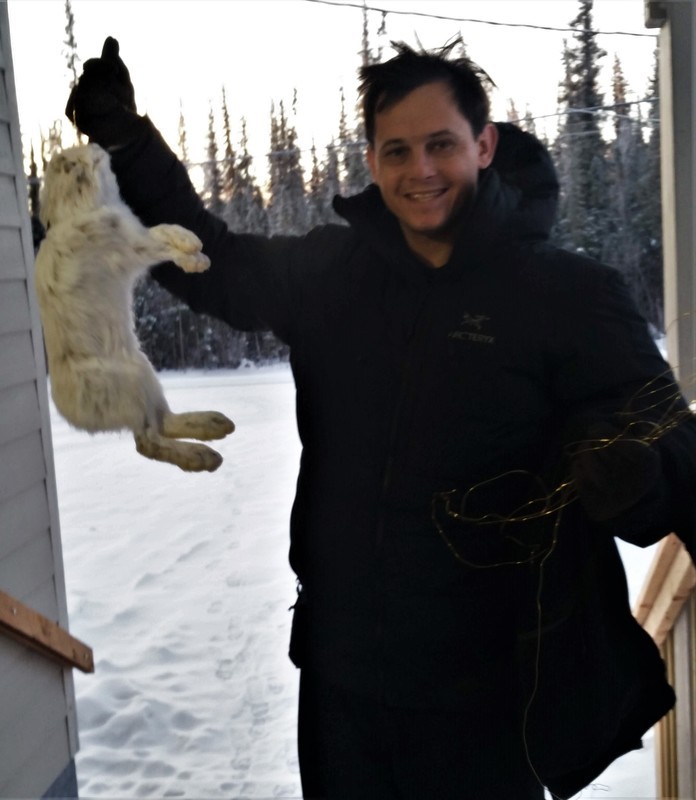
I’ve started snaring snowshoe hares this winter. They’re a hare with giant back feet, for staying aloft on the snow. They’re brown in summer but turn white in the winter for camouflage. Adults weight about 1½kg of mostly lean, red meat.

Snaring rabbits (or rather, hares; but let’s just say “rabbits” for simplicity over accuracy) is a common practice up here. Though local trappers usually focus on animals that yield more valuable pelts, they’ll set a few snares for bunnies too. A few people have told me that they’re mostly used to make a delicious rabbit stew.
The rabbit snare is a very simple trap. It’s just a loop of wire, set on the ground at about rabbit height. The wire is twisted around itself so that any pressure against the loop makes it tighten. Ideally, the snare is placed in somewhere that rabbits have passed before, and then a few sticks placed in the ground around it to encourage the rabbit to go through the snare. When they enter the snare, it tightens and a rabbit will usually jump away hard in panic and keep jumping and pulling, breaking their neck or choking them quickly. It’s a quick, merciful end. Wire snares are considered one of the most humane ways to trap.

Except, apparently, when it doesn’t go like that. Sometimes, a rabbit won’t panic. Sometimes they’ll realise they’re stuck and hunker down instead. Eventually either a predator will find and eat them, they’ll freeze (it’s been -50°C lately) or the trapper will return and end their ordeal.
A trapper usually heads out to check their snares at dawn, as soon as they can see. People tell me that it’s to beat wolves, wolverines, foxes and other rabbit-lovers to the tasty, immobilised meal. If that was all there was to it, I’d stay in bed most days—let the hungry predators have an extra meal, I can sleep in and just go to the store if I need to. But I have been heading out at the break of dawn to check my snares, every single day.
Call me a naive, bleeding-heart southerner, but to me it feels like the rabbits and I have a far more serious compact. I don’t know what goes through a rabbit’s head; probably not much. I don’t know if a rabbit feels or experiences things the way I do, if there’s an “I” behind its eyes, if there’s something that it’s like to be a rabbit. But I suspect that there is. I don’t have any problem with hunting or trapping for food, it’s the way people and other predators have lived up here almost as long as there has been life here. It’s certainly more ethical, humane and sustainable than the ways that most of the meat we eat comes to our plates, and yet…
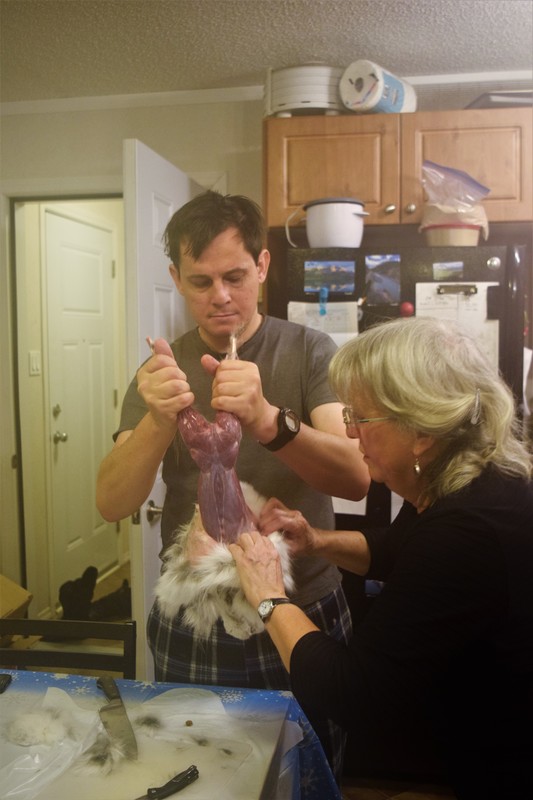
Every morning I wake to the awareness that I’ve deliberately set traps out in the world, traps that my prey can’t comprehend, traps that could have put them into a terrifying situation. Even now there could be another conscious awareness out there, another sentience, alive but trapped, struggling in confusion and fear because of something that I deliberately, knowingly did. The least I can do is drag my lazy arse out of bed as soon as it’s light enough to see (thankfully that’s around 10:30am these days), and end their suffering quickly.
This is my promise, my compact with my prey. Yes, I will use tools beyond what they can comprehend to try to catch and eat them, but I will also do whatever I can to make their end quick and painless. I’m sure life will eventually throw hurdles and conflicting priorities at me serious enough that I’d break that commitment, but it turns out that “It’s cold outside and I wanna stay in bed” is not among them.
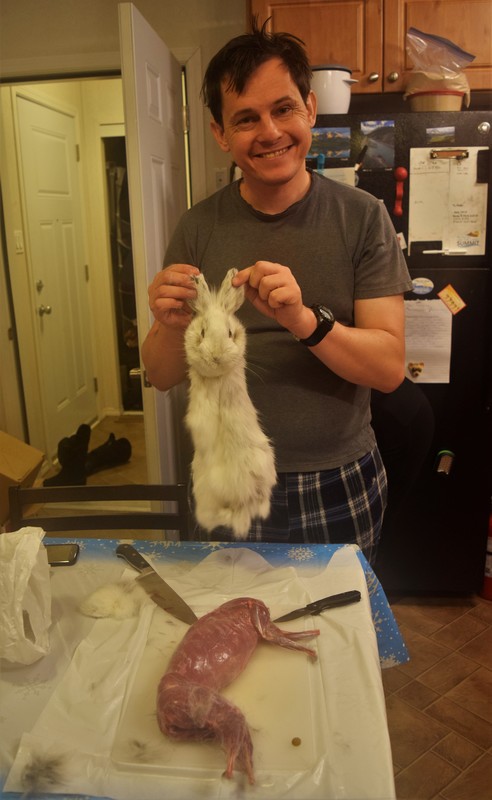
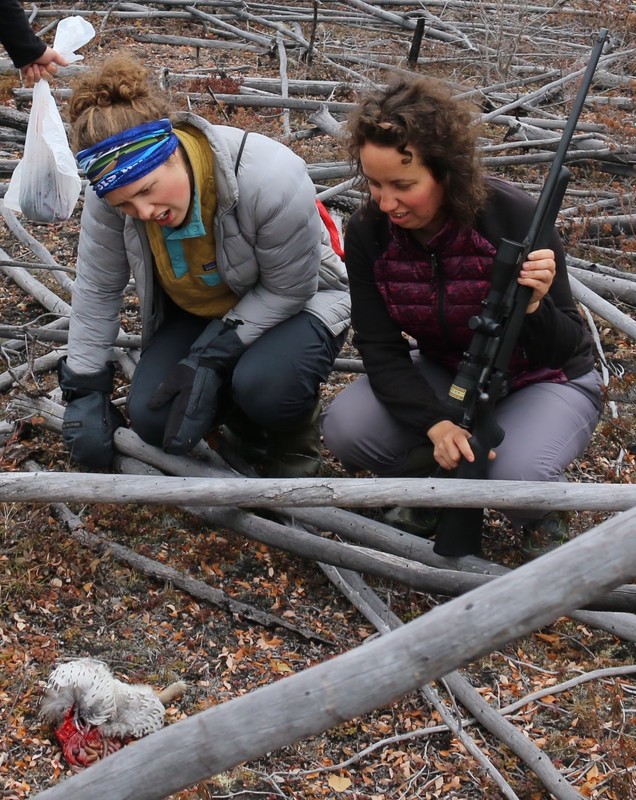
So far I have only succeeded in snaring one snowshoe hare, and it was already dead when I arrived. I’m not looking forward to eventually finding one still alive. Apparently the technique is to put your thumbs behind its neck, your fingers under its chin and pull up and push through, driving your thumbs through its spine and killing it instantly.
Coming up soon (when I’ve caught enough): “Rabbit Recipes” and “Working with Rabbit Fur Textiles”.
*Note: this story was written in January, but not published until March. Maciek has since caught 3 rabbits in total.